 |
Theory |
 |
|
Theory |
|
To find any point necessary to duplicate any flat
shape, you only need three measurements plus which of the
measurements is right and which is left. First, you place
the primary pivot blocks a given distance apart. It is
easiest of the pivot holes in these blocks fall along a
single line of the shape, in corners of a single side so to
speak, as it takes care of one side. For ease, put one of
the tapes into the pivot hole and measure the distance to
the outer side of the second block. In the preferred
package, there is a second set of these pivot blocks so that
they can be immediately attached to the blank material from
which the piece will be cut. Originally, there was a
special block for the marking piece, but using a second set
of the flat pivot blocks is more accurate. The holes
resulting from the insertion of the pins will be inside of a
joint and thusly will be covered in the final work.
Now, pull the tape on the wall out until it's long
enough to reach your first point. Once it's long enough,
bring the slider block up until the pointer in it points
directly into the "corner" you're measuring and lock the
slider block into place with the quick clasp. Designing a
single slider block to fit into every type of corner was not
feasible, thus the slider block has attachment holes for
pointers. As long as the marking pointer, with the pen in
it, and the measuring point stick out the same distance from
the same point in the slider block, this will work. Do the
same thing with the other tape. Then, you have all three
measurements and can plot the point on the blank.
Plotting the point can be done with the same set of
tapes, or with a second set as long as the measurements are
the same. Since using the pens in the slider blocks would
undoubtedly result in debris getting into the ink, a second
set is advisable. Move the right tape into the right hole
and the left tape into the left hole. Estimate where the
two lines will cross and use the pens to draw arcs. The arc
from the left tape will cross the arc from the right tape at
only one point and that's the point you want. Continue this
process until you have as many measurements as you need to
form the shape.
The AutoAngler is a very simple measuring system
comprised of a series of cast blocks, a set of modified
retractable tape measures and slider blocks on the tapes.
Each of the cast blocks has a set of tacks embedded into it
so that it can be firmly attached to a surface with a firm
tap, yet be easily removed. Other configurations, also
covered by the specifications of the allowed application,
allow for the tacks to be replaced with a strong magnet, or
even having these pivot blocks attached to the end of a
"quickclamp." Every tape, a multiple of 2 per set is best,
has a slider block attached to it with a quick catch
mechanism to hold it in place once the measurement is taken,
thusly eliminating the need to be able to read the tape
measure.
A pivot, in the prototype design a pop rivet, is placed
on the end of each tape in place of the catch. This pivot
fits into the pivot hole in the pivot block and is held into
place by a magnetic sleeve pulling down on the washer.
Magnetic sleeves hold the pivots down, however, they are
easily removed so that the blocks can be stored separate
from the tapes. For simplicity, the slider blocks can be
disassembled so that they can be attached to the tapes
without having to remove the pivots. Also, the
replacability of these parts components for a secondary
market in spare parts.
There is no limit to the material which can be measured
or marked using this system. With the right markers and the
right attachments, glass, steel, plastic and even cloth can
be marked with ease. The system can even be used to check
the positioning of poles by the distance any one pole is
from any two other poles. Almost all handymen know of the
3-4-5 method of checking square and can use the AutoAngler
to check it. Knowing the distance from fixed points also
allows for the locating of buried conduits and pipes. The
only limitation to the AutoAngler is the limit of the
imagination of the user.
{These drawings are not to scale.}
Pivot Block #1
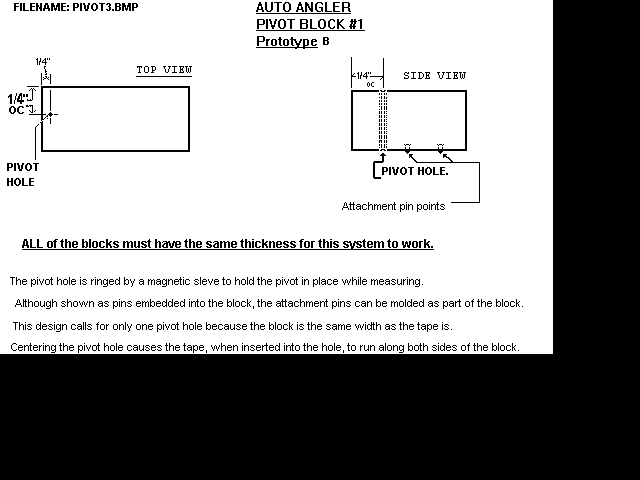
Pivot block one is often referred to as the face block
because it was intended to be placed on the face of the
surface being measured. Originally, there was an offset
block which was used in the marking out of the shape on the
blank, however, this was done away with in favor of using
two sets of this block, one to measure and one to mark out
the shape. This block is most commonly used on sill plates
and other places where the block has to be mounted to the
surface being measured.
Although only one pivot hole is shown, the original
design called for two. Since the pivot is mounted into the
same hole as the original catch on the tape, it is 1/8" from
the edge. The pivot hole is mounted into the block so that
the edge of the tape will touch the edge of the block when
inserted into the hole and therefore the pivot hole is half
the tape's width from one edge of the block and 1/4" in.
This 1/4" offset, half the tape's width, allows the tape to
pivot without the edge of the tape moving off the edge of
the block and possibly hitting something. With the depreciated two hole
design, the pivot holes are 1/4" in from each edge, as
opposed to the 1" block width shown in the two hole design,
so that the tape will run along whichever side of the block
the pivot hole it is inserted into is on. Also, the one
hole design requires that the block be the same width as the
tape so that the pivot hole is the same distance from both
sides of the block. Provided that the blocks are always the
same, the pivot hole placement doesn't matter that much.
See pivot block 2 for the 2 hole design and remember that
the one hole and two hole design cannot be mixed.
The two hole design is used so that the same pivot
block can be used on the right side, where the pivot hole
would be in the lower right corner of the block, or the left
side where the pivot hole will be in the lower left corner.
At the top of the work surface, these pivot holes would be
in the upper right and upper left respectively. I recommend
that, going with the one hole design shown, the block be the
same width as the tape rather than the 1" width shown. The
two pivot hole design is the original design and the only
design currently in use.
If you noticed the ray-traced image on my home page, you will
see that there is a second hole in the newest design. One hole
sticks through the bottom, in front of the attachment spikes.
This is the original hole. Clearly, this hole can be seen from
the bottom only because it goes all the way through since this
side of the block will be firmly attached to the surface being
measured from. The tape's pivot goes into this hole on the
other side of the block
The second hole can be seen on the side of the block. This hole
is needed to do inside measurements when the surface the block
attaches to is a frame around the hole to be filled and not one
of the shoulders on which the final piece will rest. This can be
done to mark out windows and doors where the sholder which acts
as a stop for the finished piece would be too small or fragile
to handle the attachment spikes molded into the pivot block.
Magnetic sleeves should ring the pivot holes in order
to hole the metal pivot of the tape down into the pivot hole
during measurements. If this pivot slips up, accuracy is
lost. The attachment pin points are simple pins which are
just long enough to hole the block to the work surface with
a firm tap, but are not so long that tools would be required
to remove it later. With the coming reliance on steel
studs, these attachment pins can be replaced with magnets.
Pivot Block #2
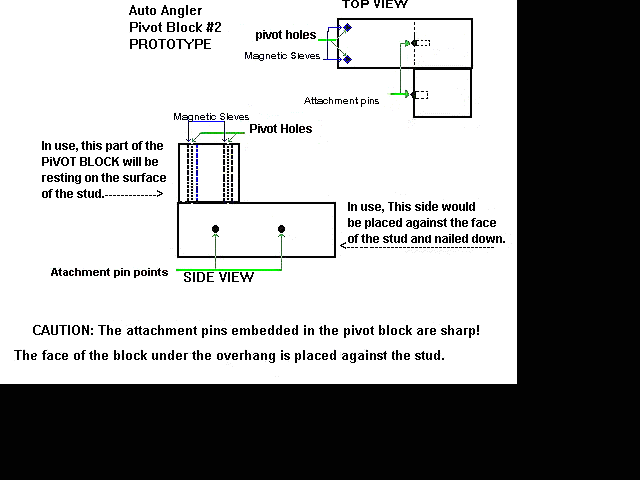
Pivot block number 2 was designed to be mounted on the
side of the stud. This acts as a guide in carrying the
pivot holes to about the center of the stud's face. Since
the idea behind drywalling or paneling is to have the joints
between pieces fall in the center of the stud faces, this
block automatically handles centering the pivot hole for the
AutoAngler. The common two hole design for the pivot holes
is used here, but a one hole design can be used if the part
of the pivot block with the pivot holes is slimmed down to
the same width as the tape.
Again, the pivot holes are 1/4" from the sides and 1/4"
from the edge of the upper block to match the measurements
of the tape. These measurements depend on the tape used and
the 1/4" figure comes from the tapes used in the prototype
AutoAngler. The magnetic sleeves are simply magnetic
cylinders which pull on the metal pivot shafts of the tape
in the same way as a solenoid pulls in a central rod. These
attachment points can also be replaced by a magnet to work
on metal studs or an appropriate attachment system for
whatever material is being measured.
Tape Pivot Design
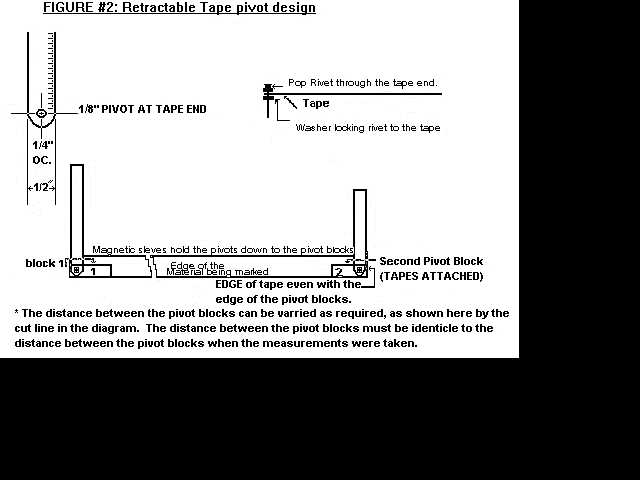
This drawing shows the actual tape pivot. The tape
used was 1/2" and the hole is simply a replacement of the
rivet which used to hole on the catch of the tape. You will
notice that the end of the tape has been cut to a radius.
This is so that the corners of the tape do not hit whatever
surface can be next to the pivot block when the measurement
is taken. The pivot blocks shown are the two hole design
although only one pivot hole is shown.
These pivot blocks are shown as they would be used,
with the pivot holes closest to the outer corners of the
work piece. Here, the pivot blocks are shown attached to
the edge of the blank material from which the final piece
will be cut. Remember that these pivot blocks must be the
same distance apart as they were when the measurements were
taken and that the outer edge of the pivot blocks should
have touched part of the shape somewhere. The corner of the
pivot block which touched a corner of your shape is
important as it is one of the points that you need to draw
out the final shape on the blank.
The AutoAngler's pivot is currently a pop rivet held
into place by a washer under the tape. This design is
preferable in that it is easy to replicate and creates a
smooth surface where the tape moves against the pivot block.
If the tape catches on the pivot block, the pivot will rise
up and the measurement will be inaccurate.
Slider Block Prototype.
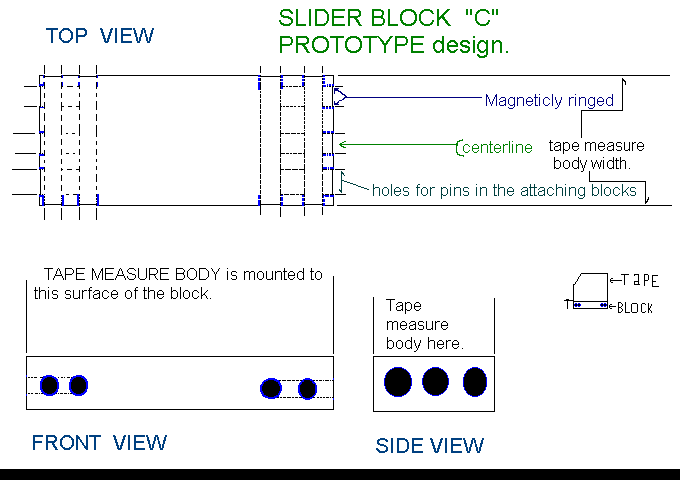
The slider block prototype is the most complex piece of
the AutoAngler which has to be made. This system does work
without it, yet it requires more skill on the part of the
user. Everything must be constant for the AutoAngler to
work. Change any positioning in any way and the AutoAngler
will not be precise. Using the extra pieces makes the
AutoAngler usable without the ability to read the tape and
more reliable.
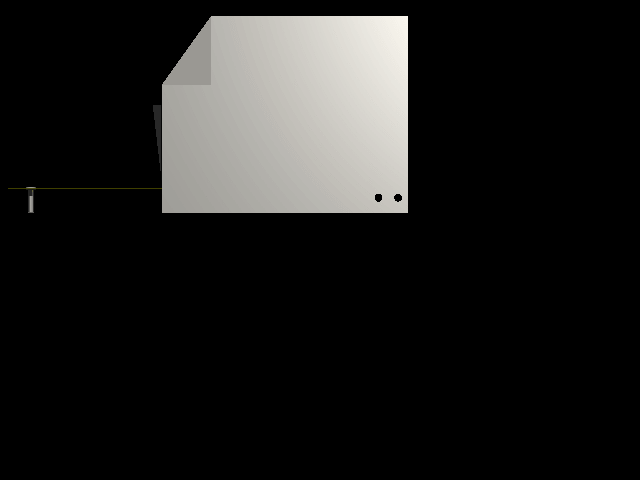
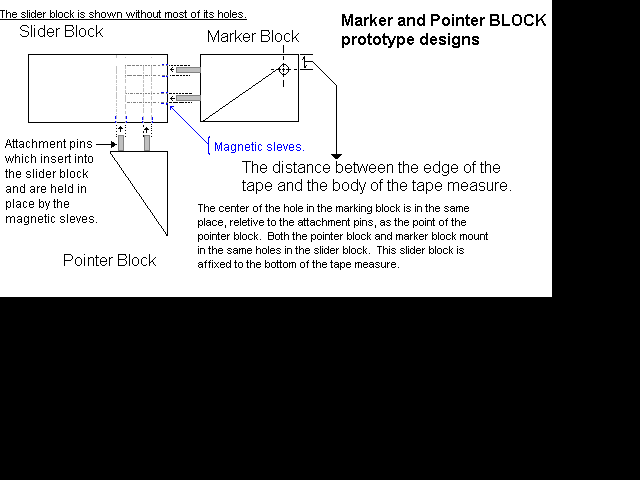
This is the latest design of the slider block. It is comprised
of a block containing magnetically ringed holes which is then
attached to the bottom of the tape measure body. Since the
tape measure is a commonly available device which contains the
quick locking and unlocking mechanism, the manufacture of the
device is greatly simplified by attaching the slider block to
the tape body.
Presently, we are using a prototype which uses an electronic
system to read the tape. The memory in this tape is a
convenient addition to the system. This tape design is not
covered by the patent, however, its use as part of the
AutoAngler is well within the specifications of the AutoAngler.
All of the moving parts of the AutoAngler are contained in
whatever retractable tape is used as part of the system.
 |
Pointers |
 |
This pointer block design has an unspecified length. The
prototype is one inch from the edge where the attachment pins
are to the point. The width is proportional so that the strait
side of the pointer, perpendicular to the side with the pins,
runs back from the edge of the tape body by the same distance as
the enge of the retractable tape is from the same edge on the
inside. Clearly, the tape wouldn't fit into its case unless the
case was wider than the tape inside of it. The strait side of
the pointer is meant to continue the edge of the tape, not the
body.
Aside from the pointers, marker attachments are used. The only
function of the marker attachments is to make sure that the pens
used to mark out the points on the work surface are in the same
position reletive to the slider block as the pointers were. It
is important to the use of the AutoAngler system that the pens
be in the same place for marking out the shape as the points were
when measuring the shape.
Originally, the pens were attached into the slider block directly.
This design works, but required that the pointers be large enough
to hold the pens in place. This resulted in the pointers being
prohibitively large. It also resulted in the tips of the pens
becomming contaminated while the measurements were being taken
with the AutoAngler.
Other attachments can be designed and used within the
bounds of the AutoAngler patent. This design is
simply the current embodyment and can be modified as
required for any situation as is shown by notes in this
document. Other designs are clearly possible and development
is continuing at this time.
What I'm seeking in relation to the AutoAngler is a
company to license the patent on a royalty basis and
manufacture the device for sale to the general public. Such
marketing is beyond my skills and I would prefer to avoid
any reliance on my weak skills in this area if at all
possible leaving it to a more skilled party. I am willing
to provide whatever services are required, however, in order
to see to the sale, production and marketing of this
patented [#5692312] device.
Currently, the application has been approved and the Patent
was issued on 2, December 1997. The AutoAngler is now
protected and can be licensed to industry at any time.
The AutoAngler should be simple to mass produce in that
most of the complex parts already exist, including the tape
measure, and the majority of all parts are simply molded
metallic blocks. Of the remaining parts, only the quick
catch of the slider block requires more than simple
machining of molded or pre-manufactured parts and that has
been done away with in favor of attaching a utility block to
the botom of the tape block. This utility block is a simple
molded block with a series of magnetically ringed holes in it.
Attachments, like the triangular block in the slider block
sketches, plug into this block. Additionally, a block which
holds a pen can be plugged into this utility block to make
marking the arcs easy.
My primary e-mail address is:
autoangler@dotguy.net.
A simple demonstration tape is available.
SPAMFREE address in use. You know what to do.